The model training has been concluded;
Intuition
Human feedback is limited. We want to collect aesthetic feedback efficiently, and at scale.
→ How can we make better use of social media feedback?
Twitter Data
Twitter data is inherently noisy:
From what I recall, the figures are roughly:
- About half of the posts are not artworks (~40%).
- Many are from amateurs (the mean like count is around 80).
- AI-generated images are widespread and unlabeled.
- We need to distinguish actual illustrations from rough sketches, gacha game screenshots, and various unrelated content.
- We also need to avoid including Nightshade-protected images.
This experiment focuses on the transformation side of the problem, leaving other challenges for later.
Transformations on Twitter
Twitter engagement data (like counts) tends to follow a normal distribution after a log transformation:
- (Also See: lark document)
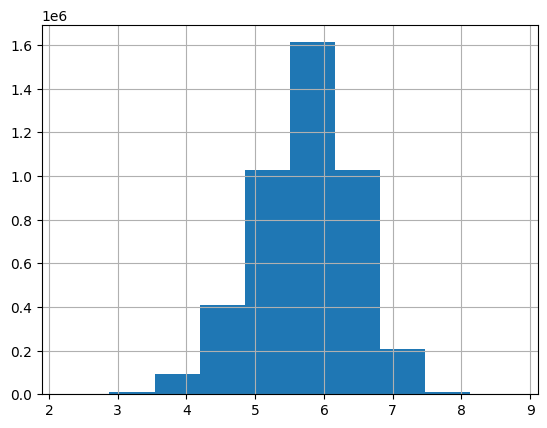
Based on these characteristics:
- Twitter likes follow an inverse log distribution.
- We want to distinguish high-quality images from lower-quality ones.
- The most informative range appears to be between 200 and 20k likes.
We propose three transformations:
# Define transformations
def transform1(x):
    # Converts the distribution to something close to bell-shaped
    return np.log1p(x)

def transform2(x):
    return np.sqrt(x) * np.log(x + 10)

def transform3(x):
    # Emphasizes the range between 200–20k likes, which empirically captures key distinctions in aesthetics
    # Still right-skewed; results in slower convergence and significantly higher loss (~10–20x compared to log1p)
    return np.power(x + 1, 1/3) * np.log(x + 10)
Discussion on Transformations
Better gradient behavior?
log1p(x)provides a smooth, well-behaved gradient.- In contrast,
cbrt × log(transform3) involves a power transform and lacks a closed-form gradient, making optimization harder.
Better numerical range?
cbrt × logwas designed so that, under constant error in the transformed space, it minimizes absolute error in the range of 200 to 20k likes—an empirically important aesthetic band.- We trained on both
log1pandcbrt × log, and evaluated error across real value ranges (after projecting back). - Finding: both transformations tend to underestimate the popularity of good artworks.
Better architecture?
- Trained with
log1pon both DINOv2-Large and SigLIP2-Base. Compare differences in error profiles and convergence.
Better hyperparameters?
- In the DINOv2 experiment, slightly adjusted learning rate. Results suggest sensitivity—worth deeper inspection.
Transformation vs. loss penalties?
- A good transformation can simplify the optimization problem, possibly avoiding the need for custom loss penalties.
- However, some transformations—like
cbrt × log—can distort the gradient too much, making convergence more difficult despite better range coverage.
Distribution mismatch?
- Predictors trained on full Twitter data tend to underestimate like counts for high-performing artworks.
We’re predicting Twitter favorite counts for artworks using either
log1p(x)ortransform3 (cbrt × log)—applied to the target or as a feature.
After training, predictions consistently fall below actual values. With more training (e.g., from 9k to 22k iterations), the total predicted likes decrease, despite loss continuing to improve.
Example:
# some sample labels on the same set
sum(predictions_9k), sum(predictions_22k)
(258.18, 242.20)
This underprediction aligns with the underlying distribution:
- Twitter engagement is heavily skewed—most posts have low like counts (mean ~80).
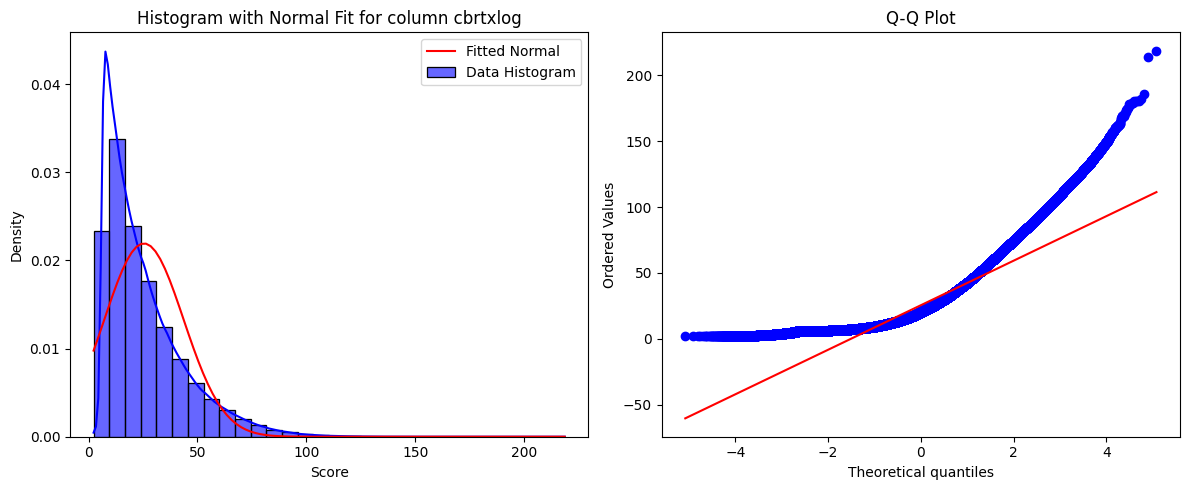
- After transformation, the target distribution becomes:
count 3,632,472
mean 25.44
std 18.20
min 2.30
25% 11.63
50% 20.10
75% 33.92
max 218.70
Key insight:
MSE penalizes large errors more heavily.
So: when the transformation expands high-value ranges (e.g., cbrt × log), the model becomes more conservative—it minimizes loss by shrinking predictions near the dense low-like region.
Additional observations:
- Even after transformation, predictions remain too small compared to the original like counts.
- Longer training (more steps) often leads to lower predictions, not higher.
Model Outcomes
Two versions of the model using the cbrt × log transformation are available on Hugging Face:
incantor/aes-twitter-cbrtxlog-siglip2-base-s9600
- Early checkpoint (~9.6k steps)
- More uniform predictions, avoids overfitting to outliers
- Often preferred for evaluation due to stable performance
- Sample outputs show cleaner aesthetic curation
incantor/aes-twitter-cbrtxlog-siglip2-base
- Later checkpoint (~22k steps, 1 epoch)
- Trained on ~3.6M Twitter favorites
- Captures broader signals, but more sensitive to noisy high-like posts (e.g., memes)
- Produces slightly more diverse but less consistent scores
Notes:
- Trained with
SigLIP2-baseoncbrt × logtransformed favorite counts to emphasize mid-range aesthetic signal (200–20k likes). - Despite improved numerical targeting, the model tends to underpredict high-like posts—similar to
log1p—due to MSE and skewed data. - Longer training reduces predicted scores slightly (e.g., from 258 → 242 on a fixed sample), aligning with earlier loss trends.
# sample from eval:
sum(preds_9k), sum(preds_22k)
# → (258.18, 242.20)
Performance Snapshot:
| Metric | Value |
|---|---|
| Eval RMSE | 13.84 |
| Eval MSE | 191.52 |
| Train Loss | 221.35 |
| Eval Samples | ~72k |
These values are relatively high—likely due to the expanded value range and more erratic gradients from the cbrt × log transformation.
Evaluation:
- Model is not state-of-the-art, but usable for aesthetic ranking with Twitter-style engagement.
- Produces visually coherent high-score outputs from 10k+ unseen images.
- Earlier checkpoint tends to filter better; later checkpoint captures more outliers.
Appendix: Error Visualization
Error Simulation (1): Global Range
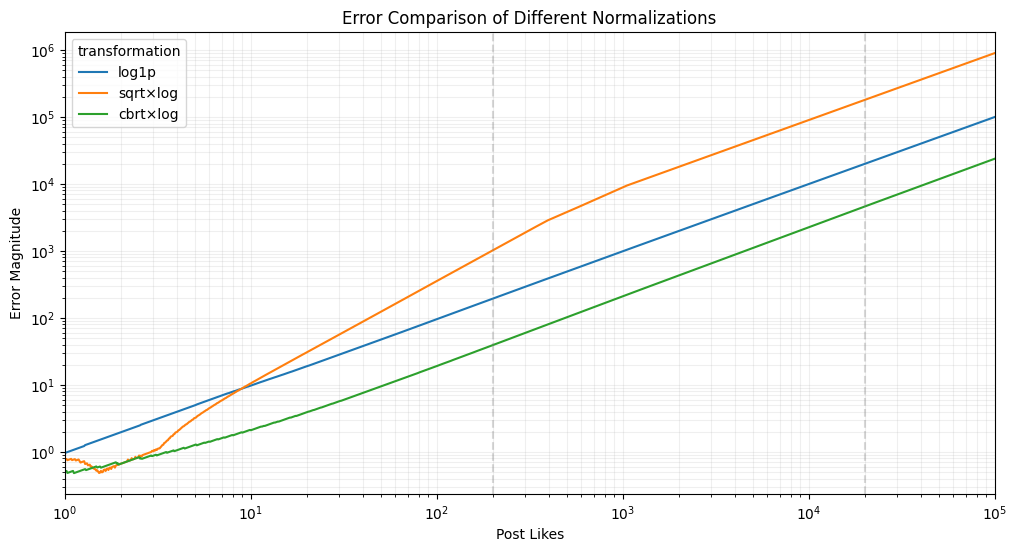
We simulated how a ±10% error in the transformed space maps back to original values for each transformation. Results were plotted over a wide range of post likes (1–100k).
Transformations:
def transform1(x): return np.log1p(x)
def transform2(x): return np.sqrt(x) * np.log(x + 10)
def transform3(x): return np.power(x + 1, 1/3) * np.log(x + 10)
The method used binary search to estimate inverse error in original space, assuming uniform relative error in the transformed space.
Outcome:
cbrt × loghas the lowest error in the upper range (20k+), but not always in the mid-range. The curve is less steep and better spaced for higher values.
Error Simulation (2): Focused Range (200–20k)
See full notebook: Error Analysis Comparison
To better understand the behavior in the range we care about most, we zoomed in on 200–20k likes, using the same method.
# Average errors in 200–20k range
{
    'log1p': 10982.25,
    'sqrt × log': 1664.97,
    'cbrt × log': 2299.06
}
Summary:
| Transformation | Avg Error (200–20k) |
|---|---|
log1p | 10,982 (worst) |
sqrt × log | 1,665 (best) |
cbrt × log | 2,299 (middle) |
Takeaways:
sqrt × logperforms best in the 200–20k range—the aesthetic sweet spot.cbrt × logoffers a smoother curve and excels at higher values, but sacrifices mid-range precision.log1psignificantly underperforms across the board.
This highlights a key tension: optimizing for aesthetics may require non-standard transformations that deviate from typical log-based scaling, even if they complicate gradient behavior.